Confident, responsible AI use across the enterprise.
Most enterprises are being asked to act on AI without an evidence-based view of their own readiness. VCL AI Adoption establishes that view, builds the capability each level needs, and aligns leaders, managers and professionals on what AI must deliver.
Adoption has outpaced capability.
AI is already in use across most workforces. Capability, governance and evidence have not kept pace, and regulators now expect all three.
58%
of employees already use AI at work, exceeding 80% in Saudi Arabia and the UAE
70%
of organisations use AI in at least one business function
40%
of employers cite skills as the main barrier to AI adoption
+55%
year-on-year rise in publicly reported AI incidents
AI literacy is now a regulatory expectation. Article 4 of the EU AI Act requires organisations that deploy AI to ensure a sufficient level of AI literacy among their staff, and the NIST AI Risk Management Framework and ISO/IEC 42001 both place workforce competence at the centre of responsible AI.
Sources: Stanford HAI, AI Index Report 2026 · OECD AI surveys of employers and workers · OECD, AI and Skills, 2026 · EU AI Act, Article 4
Boards are pressed to act. Without evidence, the choice is between over-investing on hope and standing still on doubt. Neither is a strategy.
AI rewards judgement, not tool operation.
Earlier technologies rewarded the people who learned the tool. AI rewards the people who can judge its output, and exposes the organisations that cannot.
Output must be verified
Generative AI is probabilistic and fluent. The same request can return different answers, and a wrong one reads as confidently as a right one.
Value and exposure grow together
Every productivity gain arrives with matching exposure: data leakage, bias, confidentiality and intellectual property risk.
Behaviour decides the outcome
Over-reliance and quiet resistance are both recognised failure modes of adoption. Neither is solved by a tool licence or a policy memo.
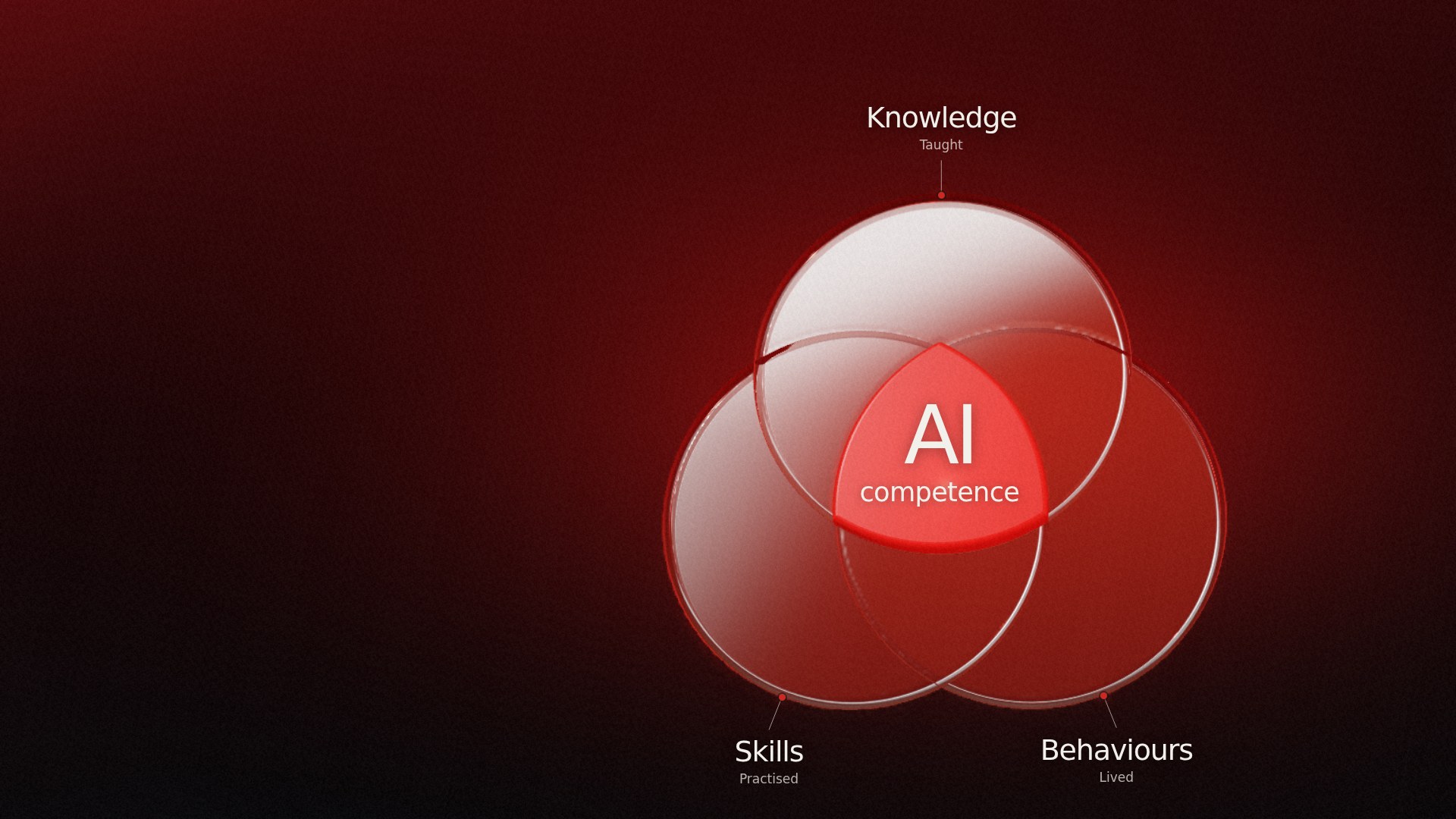
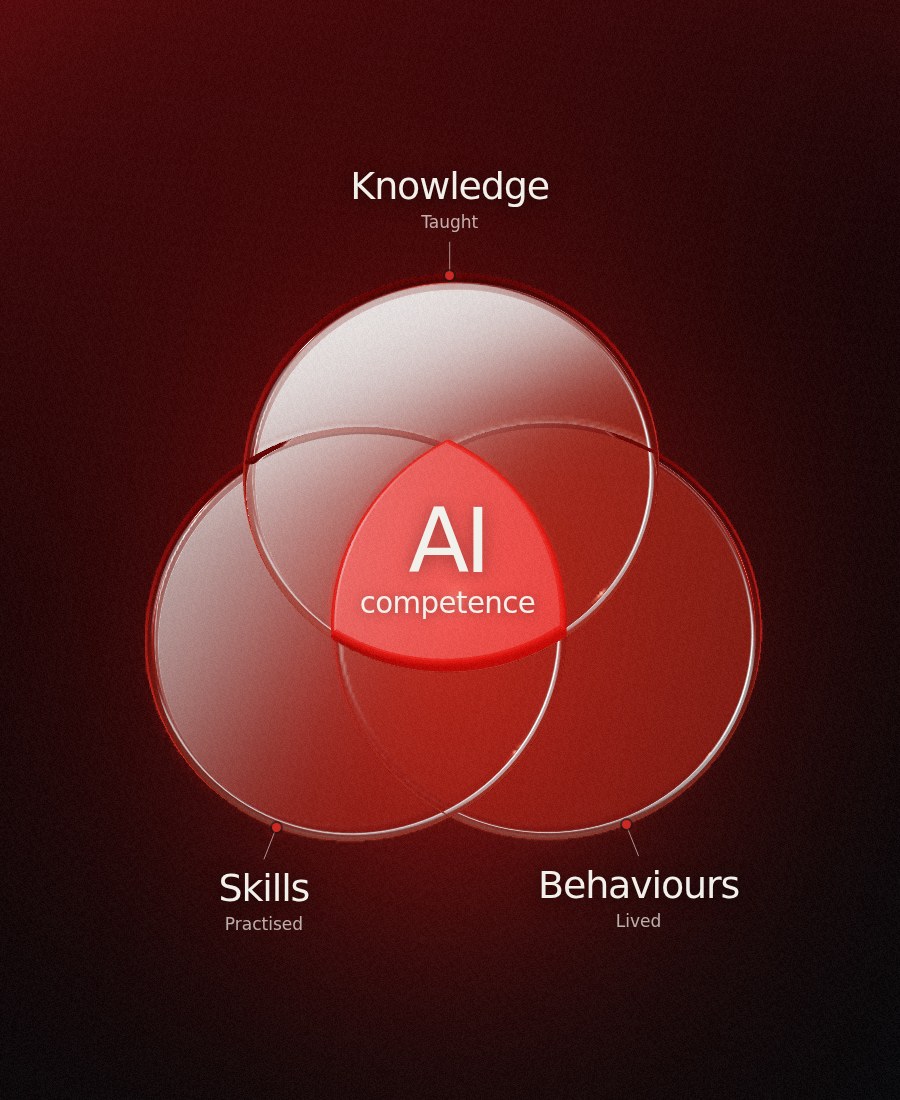
Where knowledge, skills and behaviours meet.
One of the three is never enough. AI competence sits where all three overlap, and that is where it is measured.
One engagement, three levels, four phases.
Leaders, managers and professionals move through the same four phases in parallel, each on its own track. Every phase closes with an output the enterprise keeps.
Assess
3 to 4 weeks
Align
2 to 3 weeks
Deliver
8 to 12 weeks per cycle
Advance
3 to 4 weeks, then quarterly
Executives
Interviews and a leadership readiness read
Direction, decision rights and guardrails agreed
Six briefings, each producing a governance deliverable
Results reviewed, next cycle decided
Managers
Survey and AI tool inventory across teams
Team roles and expectations set
Six workshops with assignments in their own teams
Team readiness re-measured
Professionals
Survey of what people know, do and actually use
Sanctioned tools and rules communicated
Five sessions on their own work cases
Behaviours re-rated four weeks on
What changes.
The engagement is judged on the shift it produces, measured against the baseline it started from.
Today
After the first cycle
AI use is uneven, unmeasured and largely unseen
A capability baseline per level and role, on a government-backed standard
Expectations split between hype and scepticism
One agreed direction, with decision rights and accountabilities by level
Confidential data on personal accounts
Sanctioned, observable use on governed tools or a secure sandbox
Training completions and satisfaction scores
Evidence per competency: knowledge, skills and behaviours, before and after
Risk discovered after the first incident
Usage rules, risk entries and an escalation path in place before scale
What you will hold.
Deliverables, not attendance records. Each is produced inside the engagement and retained by the enterprise.
Executives
AI strategy on a page
Priorities, guardrails and decision rights, signed off by the board.
Leadership
AI usage policy
Sanctioned tools, the limits of acceptable use and who decides what.
Executives
Risk register entries and an escalation path
The behavioural risks of adoption, named, owned and routed.
Managers
Team readiness assessment
Risk and readiness per team, with a live compliance view.
Managers
Opportunity cases
Use cases built from team insight, ready for leadership to act on.
The board
Cohort report per level
Capability per competency, before and after, with the workplace evidence behind each score.
Built for the enterprise.
In an enterprise, a direction set at the top holds only if managers can carry it and professionals can apply it. The solution develops all three levels at once, with explicit accountabilities and one measure.
Uses AI to
Accountable for
Leaves with
Executives
See the journeyDecide where AI creates value and where it must not be used
Direction, guardrails, investment and public trust
An AI strategy on a page and a governance pack the board can sign
Managers
See the journeyRedesign team work and keep use inside the rules
Team readiness, compliance and the opportunity pipeline
A team readiness assessment and opportunity cases leadership can act on
Professionals
See the journeyDraft, analyse and decide faster, and verify before acting
Verified output, protected data and escalation when unsure
A verified application log and a personal development plan
Why it holds up.
Measured
Knowledge tested before and after, skills assessed on the work produced, behaviours rated at baseline and again in the workplace.
On a government-backed standard
Mapped to the UK AI Skills for Business competency framework, so capability is reported in terms a board, an auditor and a regulator recognise.
About the standardTailored
Cases from your sector, sessions on your tools, scope set by your baseline.
How tailoring worksSecure by design
Delivered on the AI tools you already govern, or in an enterprise-grade secure sandbox. No enterprise data enters a public tool.
The secure workspaceWhat it means for your function.
AI raises a different question in each part of the enterprise. Each gets a direct answer.
Executive leadership
Set the AI direction on evidence, and align the enterprise behind it.
A traceable return on AI investment that stands up to the board
AI-enabled products and services in market before rivals
Human resources
Clear roles and expectations for AI, at every level.
A workforce that adopts AI without the anxiety and quiet resistance that stall new tools
A clear picture of who holds which AI capability across a large, dispersed workforce
Learning and development
Learning built on your work, measured on knowledge, skills and behaviour.
AI learning that transfers to the job because the examples are the organisation's own work
Cohorts that work at every level of fluency without leaving anyone behind
Digital and technology
Adoption that keeps pace with the platform, on your security terms.
Adoption that matches the investment in the platform, measured beyond licence counts
Sanctioned, observable AI use in place of workarounds
Find out where each level of your enterprise stands.
Tell us about your organisation and the levels you want assessed. We will come back within two working days to plan the Assess phase with you.