Most enterprises are being asked to act on AI without an evidence-based view of their own readiness. VCL AI Adoption establishes that view, builds the capability each level needs, and aligns leaders, managers and professionals on what AI must deliver.
AI is already in use across most workforces. Capability, governance and evidence have not kept pace, and regulators now expect all three.
of employees already use AI at work, exceeding 80% in Saudi Arabia and the UAE
of organisations use AI in at least one business function
of employers cite skills as the main barrier to AI adoption
year-on-year rise in publicly reported AI incidents
AI literacy is now a regulatory expectation. Article 4 of the EU AI Act requires organisations that deploy AI to ensure a sufficient level of AI literacy among their staff, and the NIST AI Risk Management Framework and ISO/IEC 42001 both place workforce competence at the centre of responsible AI.
Sources: Stanford HAI, AI Index Report 2026 · OECD AI surveys of employers and workers · OECD, AI and Skills, 2026 · EU AI Act, Article 4
Boards are pressed to act. Without evidence, the choice is between over-investing on hope and standing still on doubt. Neither is a strategy.
Earlier technologies rewarded the people who learned the tool. AI rewards the people who can judge its output, and exposes the organisations that cannot.
Generative AI is probabilistic and fluent. The same request can return different answers, and a wrong one reads as confidently as a right one.
Every productivity gain arrives with matching exposure: data leakage, bias, confidentiality and intellectual property risk.
Over-reliance and quiet resistance are both recognised failure modes of adoption. Neither is solved by a tool licence or a policy memo.
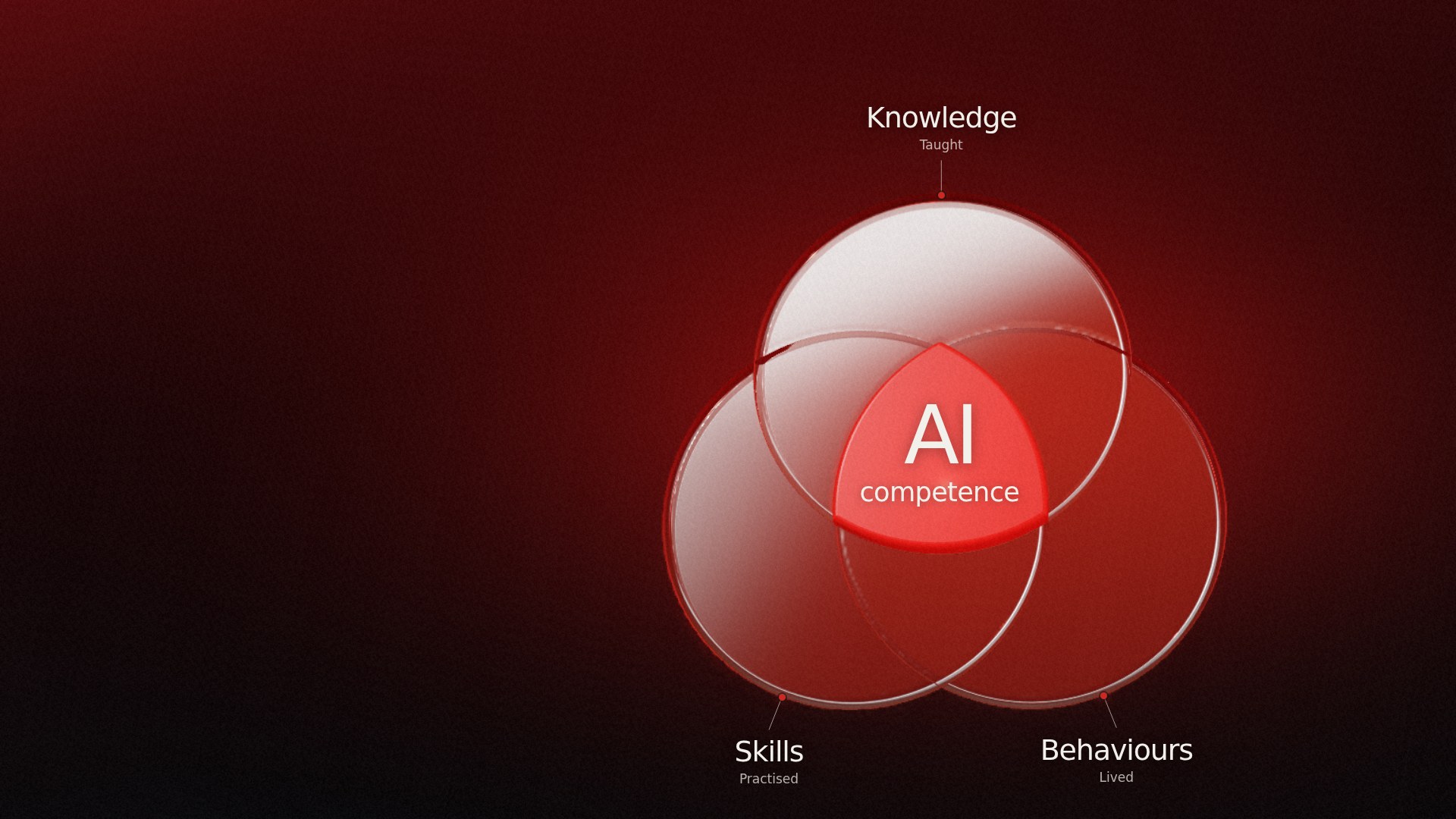
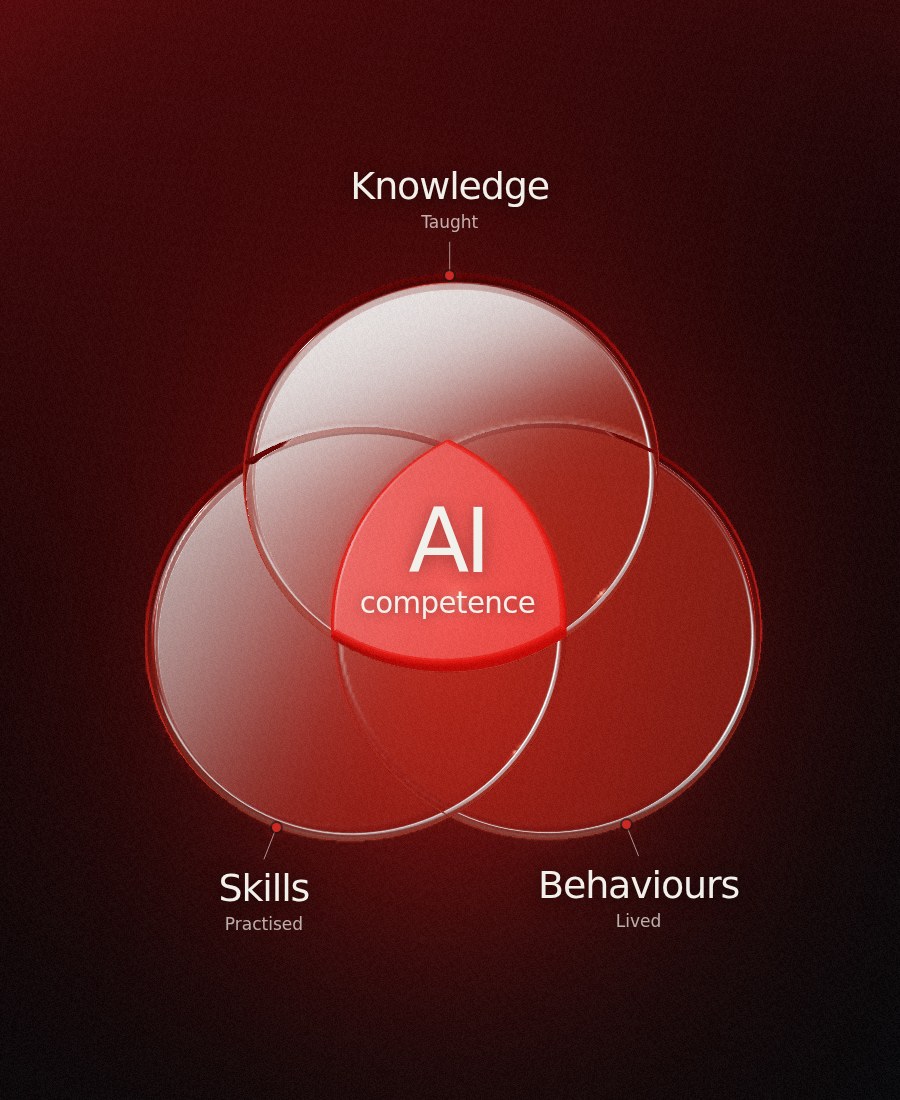
One of the three is never enough. AI competence sits where all three overlap, and that is where it is measured.
Leaders, managers and professionals move through the same four phases in parallel, each on its own track. Every phase closes with an output the enterprise keeps.
3 to 4 weeks
2 to 3 weeks
8 to 12 weeks per cycle
3 to 4 weeks, then quarterly
Executives
Interviews and a leadership readiness read
Direction, decision rights and guardrails agreed
Six briefings, each producing a governance deliverable
Results reviewed, next cycle decided
Managers
Survey and AI tool inventory across teams
Team roles and expectations set
Six workshops with assignments in their own teams
Team readiness re-measured
Professionals
Survey of what people know, do and actually use
Sanctioned tools and rules communicated
Five sessions on their own work cases
Behaviours re-rated four weeks on
The engagement is judged on the shift it produces, measured against the baseline it started from.
Today
After the first cycle
AI use is uneven, unmeasured and largely unseen
A capability baseline per level and role, on a government-backed standard
Expectations split between hype and scepticism
One agreed direction, with decision rights and accountabilities by level
Confidential data on personal accounts
Sanctioned, observable use on governed tools or a secure sandbox
Training completions and satisfaction scores
Evidence per competency: knowledge, skills and behaviours, before and after
Risk discovered after the first incident
Usage rules, risk entries and an escalation path in place before scale
Deliverables, not attendance records. Each is produced inside the engagement and retained by the enterprise.
Executives
Priorities, guardrails and decision rights, signed off by the board.
Leadership
Sanctioned tools, the limits of acceptable use and who decides what.
Executives
The behavioural risks of adoption, named, owned and routed.
Managers
Risk and readiness per team, with a live compliance view.
Managers
Use cases built from team insight, ready for leadership to act on.
The board
Capability per competency, before and after, with the workplace evidence behind each score.
In an enterprise, a direction set at the top holds only if managers can carry it and professionals can apply it. The solution develops all three levels at once, with explicit accountabilities and one measure.
Uses AI to
Accountable for
Leaves with
Decide where AI creates value and where it must not be used
Direction, guardrails, investment and public trust
An AI strategy on a page and a governance pack the board can sign
Redesign team work and keep use inside the rules
Team readiness, compliance and the opportunity pipeline
A team readiness assessment and opportunity cases leadership can act on
Draft, analyse and decide faster, and verify before acting
Verified output, protected data and escalation when unsure
A verified application log and a personal development plan
Knowledge tested before and after, skills assessed on the work produced, behaviours rated at baseline and again in the workplace.
Mapped to the UK AI Skills for Business competency framework, so capability is reported in terms a board, an auditor and a regulator recognise.
About the standardCases from your sector, sessions on your tools, scope set by your baseline.
How tailoring worksDelivered on the AI tools you already govern, or in an enterprise-grade secure sandbox. No enterprise data enters a public tool.
The secure workspaceAI raises a different question in each part of the enterprise. Each gets a direct answer.
Executive leadership
A traceable return on AI investment that stands up to the board
AI-enabled products and services in market before rivals
Human resources
A workforce that adopts AI without the anxiety and quiet resistance that stall new tools
A clear picture of who holds which AI capability across a large, dispersed workforce
Learning and development
AI learning that transfers to the job because the examples are the organisation's own work
Cohorts that work at every level of fluency without leaving anyone behind
Digital and technology
Adoption that matches the investment in the platform, measured beyond licence counts
Sanctioned, observable AI use in place of workarounds
Tell us about your organisation and the levels you want assessed. We will come back within two working days to plan the Assess phase with you.
Earlier technologies rewarded the people who learned the tool. AI rewards the people who can judge its output. Four properties of the technology explain why, and twelve patterns of behaviour determine whether adoption succeeds.
AI systems are probabilistic. The same input can produce different outputs, so dependable use rests on verification and professional judgement rather than on operating the tool.
Generative models produce fluent, well-formed content that can be wrong. Human oversight is required before output informs a decision or reaches a client.
Productivity gains arrive with matching exposure: data leakage, bias, breaches of confidentiality and intellectual property risk grow at the same rate as the benefit.
Workforce behaviour divides between automation bias and algorithm aversion. Both are recognised failure modes of adoption, and conventional change management addresses neither fully.
None of these is a fault in the technology. Each is a predictable pattern of human behaviour, which is why the solution develops knowledge, skills and behaviours rather than tool operation. All twelve are tracked from Assess to Advance.
Fluency bias
Confident, well-formed output is read as correct, whether it is or not.
Automation bias
Output that looks complete is accepted, and verification decays into a formality.
System abandonment
One visible failure, and users conclude the tool is unreliable and stop using it.
False authority
Agreement is read as a second opinion, confidence as knowledge and tone as intent.
Skill decay
Skills delegated to AI atrophy until people can no longer judge the output for themselves.
Delegation failure
Thin instructions produce poor output; users blame the tool and disengage.
Peer conformity
People who would challenge AI alone defer to it in a group.
Unsanctioned use
Confidential data flows through personal accounts when sanctioned tools fall short.
Prohibition backfire
Banning AI removes visibility and moves use onto personal devices and accounts.
Risk creep
Use expands from low to high stakes without verification standards rising to match.
Unmeasured adoption
Scale without a baseline: value cannot be demonstrated and errors cannot be traced.
Voice uniformity
Similar tools and similar prompts erode the organisation's distinctive voice.
3 to 4 weeks
A short survey, structured interviews and an inventory of the AI tools already in use establish where each level of the organisation stands.
A survey of each level to be assessed, mapped to the competency standard
Structured interviews with executives, a sample of managers and a sample of professionals
An inventory of the AI tools in use, sanctioned and unsanctioned
A baseline of what people know, can do and actually do with AI, per level
You get A capability baseline per level and a recommended scope.
2 to 3 weeks
Leadership agrees the direction and the rules before anyone is trained: what AI is for, which tools are sanctioned, who decides what, and how success will be measured.
A leadership session that converts divergent expectations into one agreed direction
Sanctioned tools, decision rights and the limits of acceptable use
Roles and expectations for AI, defined per level
Targets for the first delivery cycle, set against the baseline
You get An AI usage policy, agreed roles and targets for the first cycle.
8 to 12 weeks per cycle
Each cycle activates knowledge, applies it to real work and anchors it as working practice. Each cycle builds on the last.
Activate: concise inputs on how AI works, where it fails and how output is verified, with a knowledge check before and after
Apply: practice on the organisation's own cases, on sanctioned tools or in the secure sandbox, assessed against a rubric
Anchor: commitments and workplace assignments, followed up and rated four weeks on
Each level on its own rhythm: briefings for executives, workshops for managers, applied sessions for professionals
You get Knowledge scores before and after, assessed work products, and behaviour commitments followed up in the workplace.
3 to 4 weeks, then quarterly
The baseline measures are repeated, the change is reported, and the next step is agreed: a further cycle, another level, or hand-over to the organisation.
The Assess measures, repeated
A results report per level and per competency, with the workplace evidence behind each score
The next step agreed: a further cycle, another level, or hand-over
A quarterly check to confirm that the change has held
You get A results report for the board.
Board and executive committee. Set the direction, own the governance and sponsor the use cases that matter.
Short fortnightly briefings with ten-minute pre-reads. Each briefing produces a governance deliverable the organisation retains.
AI strategy and value
Briefing · 90 min
Governance, ethics and regulatory readiness
Briefing · 2 h
Investment, procurement and platform decisions
Briefing · 90 min
Workforce transformation and culture
Briefing · 2 h
Risk, assurance and incident readiness
Briefing · 90 min
External representation and public trust
Briefing · 1 h
An AI strategy on a page: priorities, guardrails and decision rights
A governance and regulatory readiness checklist, with criteria for evaluating vendors and platforms
Risk register entries, an incident escalation path, a workforce transformation plan outline, an external positioning statement and a stakeholder map
Middle management and team leads. Translate the direction into how their teams work, and coach adoption day to day.
Fortnightly workshops, each followed by an applied assignment completed in the manager's own team: compliance, opportunity cases and vendor oversight.
Leading by example: championing responsible AI
Workshop · 3 h
Coaching and first-line support for AI use
Workshop · 3 h
Policy, compliance and risk in the team
Workshop · 3 h · with workplace assignment
Spotting opportunities and feeding back to leadership
Workshop · 2.5 h · with workplace assignment
Managing the team through AI-driven change
Workshop · 3 h
Owning an AI initiative: alignment and third-party tools
Workshop · 4 h · with workplace assignment
A team-level AI risk and readiness assessment with a live compliance view
Opportunity cases, built from team insight, that leadership can act on
A vendor oversight assignment applying the organisation's assurance criteria to a third-party tool
Everyone who uses AI in their role. Apply AI to their own work with skill, judgement and accountability.
Two e-learning sessions, three workshops, a workplace application log and a personal development plan.
Recognising AI and your rights as a user
E-learning · 1 h
Personal data, privacy and trustworthy content
E-learning · 1.5 h
Adopting AI tools in everyday work
Workshop · 3 h
Professional judgement and responsible use of AI outputs
Workshop · 3 h
Adapting your role and growing with AI
Workshop · 2 h · with workplace assignment
A workplace application log per participant: the task, the AI output, the check applied and the decision taken
A personal development plan that responds to AI-driven change in the role
Knowledge scores before and after, and behaviour ratings at baseline and four weeks on, per competency
The AI Skills for Business competency framework defines the AI capability each role in an organisation requires. VCL applies it to the people who use AI in their roles, at three levels.
Sponsored
UK Department for Science, Innovation and Technology
Funded and led
Innovate UK BridgeAI programme
Developed by
The Alan Turing Institute, with Digital Catapult, STFC Hartree Centre and BSI
Current version
3.0.0, March 2026, refined through industry consultation
Every responsibility carried at a VCL level is a framework responsibility, and every session traces to the competencies it serves. Two areas are deliberately out of scope: technical build roles and public advocacy, neither of which sits within the population the solution serves.
Who uses AI, from AI user to AI leader
What each persona is responsible for
What must be demonstrated for each duty
Knowledge, skill and behaviour statements per competency
Applied to the people who use AI in their roles
Executives, managers and professionals
The responsibilities people carry when AI enters their work
Each traced to one or more framework competencies
The learning outcomes of every session
Executives
Board and executive committee
Leader. 8 Leader duties, unchanged.
Managers
Middle management and team leads
Change Champion, Professional (selected duties). 6 Change Champion, 3 Leader (scaled to team) and 2 Professional duties.
Professionals
Everyone who uses AI in their role
Worker, Citizen. 7 Worker and 5 Citizen duties (the literacy baseline).
Whole persona carried over, or selected duties only, as marked.
Three inputs, gathered before the first session, shape every cohort.
Before the first session we gather the situations your people actually face: the documents they draft, the decisions they check, the customers they answer. These become the cases, so no participant practises on an example from another sector.
Sessions run on the AI tools the organisation has adopted or is evaluating, or in the secure sandbox where no sanctioned tool is yet in place. Verification practice is taught to hold whichever tool is in front of the participant.
The Assess results set the scope: which sessions each level needs, how far each goes, where the first cycle begins and what the targets are. Each subsequent cycle is scoped against the results of the last.
Session length, cohort size and journey length are agreed in the Align phase.
Delivery on your sanctioned tools, or in an enterprise-grade secure sandbox. In either case, organisational data never enters a public tool.
Delivery on the enterprise AI tools the organisation already governs, under its own access controls.
Where no sanctioned tool is yet in place: named data residency, no training on inputs, one login per participant, access closed at programme end.
Data residency the organisation can name and audit.
Nothing a participant enters is used to train any model.
The same prompt can be run on two or three models. The verification practice is the same whichever tool the organisation adopts.
Issued with the first workshop invitation, sample files pre-loaded, access closed at programme end.
Safe practice is taught by example. The three questions participants learn to ask of the workspace become the three they ask of every AI tool afterwards.
Which country is my data stored in?
Is anything I enter used to train a model?
Who can see it?
Article 4 of the EU AI Act requires organisations that deploy AI to ensure a sufficient level of AI literacy among their staff. The NIST AI Risk Management Framework and ISO/IEC 42001 place workforce competence at the centre of responsible AI. The solution is designed to meet these expectations with evidence per competency rather than attendance records.